

B-1/E-23, Mohan Co-Operative Industrial Area, Mathura Road, Delhi-110044, India
- Digital Signature Software
- 06-Oct-2026
- -
- 0 Comments
A vendor emails a letter on company letterhead. New bank account, effective immediately, please update the records. The signature at the bottom looks right. Who checks?
Usually nobody and that is how payment fraud gets through. The sceptic’s question is simple and fair: how would anyone know this signature was not faked and the document was not edited on the way? Digital signature software built on public key infrastructure answers it with mathematics instead of resemblance. Still, the mathematics is only part of the answer. A signature is only as believable as the system vouching for the key behind it and that system deserves a closer look than it usually gets.
Why PKI-Based Digital Signature Software Has to Answer One Question First
Three things need settling before anyone relies on a signed document. Who signed it. Whether it changed afterwards. Whether the signer can later say it was not them.
Handwriting settles none of these reliably. A scanned image of a signature proves even less, since an image can be copied in seconds.
Imagine a finance team handling that bank detail letter. The signature matches the one on file, the letterhead is right, the tone is polite and slightly urgent. Everything points to genuine and yet nothing in the document offers proof, only resemblance. A cryptographic signature flips that: the check either passes or fails — and a single changed character in the file makes it fail.
Binary results are rare in business paperwork. That is what makes this worth understanding.
Keys, Certificates and the Authority Behind Digital Signature Software
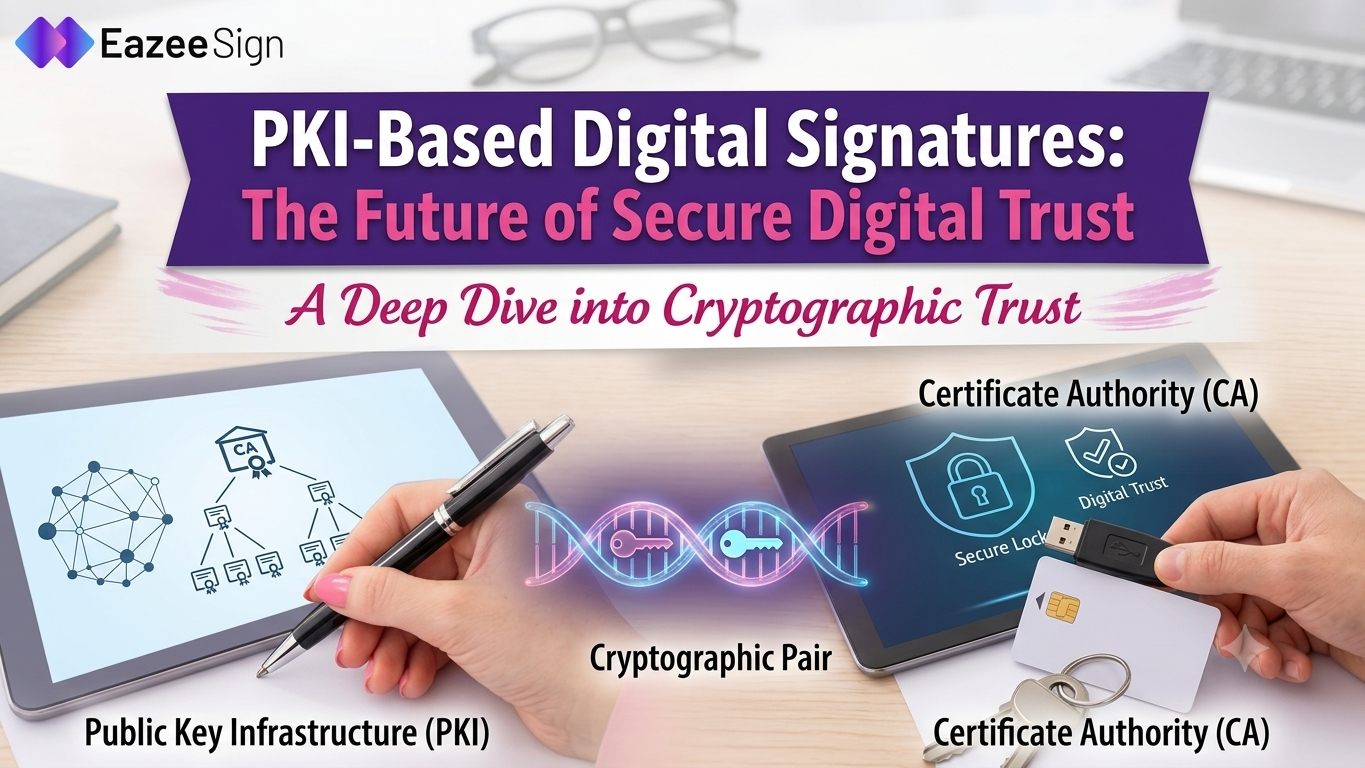
In simple terms, the mechanism is pretty straightforward. Each signer carries a pair of keys which are linked. The signer keeps the private key to create the signing signature themselves. Meanwhile, the public key can move around freely and can be used by anyone to verify whether he or she has received the signature from a matching private key and that the document has not been altered after it was signed.
But whose key is it? Anyone can generate a key pair and claim to be somebody else.
That’s the job of a Certifying Authority. It verifies the identity of a person or organisation, then issues a certificate binding that identity to the public key. Verification software trusts the signature because it trusts the authority that vouched for the key. In India, those authorities are licensed under the Controller of Certifying Authorities, with the Information Technology Act, 2000 providing the legal framework. Certificates are often kept on a hardware token, which stops the private key from simply being copied around.
So the strength of the whole arrangement sits with that third party. Remove it and the signature proves nothing about identity.
When a Certificate Expires: The Hidden Risk in Digital Signature Software
Certificates do not last forever. Most carry an expiry date and a certificate can be revoked early if a key is lost or stolen.
Sales pages rarely dwell on this. Operations teams discover it the hard way.
A company secretary at a mid sized firm found, the afternoon before a filing deadline, that a director certificate had lapsed the day before. The document was ready. The director was travelling. Renewal took longer than the deadline allowed. Nobody had set a reminder, because nobody thought of a certificate as something that ages.
A few habits prevent most surprises like that:
- Keep a register of who holds a certificate and when each one expires
- Set renewal reminders weeks ahead, not days
- Decide what happens when a token goes missing, before it goes missing
Boring, certainly. Also the difference between a calm week and a scramble.
Digital Signature Software or Electronic Signature Software: Which Document Needs What
Giving every document the highest level of signature wastes time. Giving a serious one a light touch creates risk. The skill lies in matching the two.
Certificate based signing tends to suit regulatory submissions, filings with the Ministry of Corporate Affairs and any document where a counterparty or authority specifically expects it. Digital signature software built around that model attaches cryptographic proof to a verified identity, which is exactly what those documents need.
Routine paperwork is different. Offer letters, NDAs, vendor agreements, internal approvals, consent forms. Electronic signature software is usually the better fit there: signers click, type or draw and the platform records the activity around each signature. According to EazeeSign’s site, electronic signature refers to a general idea and digital signature to the type of signature that has certificates attached to it. It mentions that electronic signatures are under the IT Act, 2000. The platform provides audit trails and two factor authentication for accessing documents and has also been issued SOC 2 and ISO certifications.
Which one applies depends on who receives the document. One question to the receiving party beforehand beats signing everything twice.
Where an eSign App Fits Around PKI-Based Signing
Hardware tokens belong to desks. Approvals do not. In a Tuesday afternoon, a purchasing manager who visits a site will not be able to plug any device and must still approve the purchase order, the documents that do not require a certificate can be signed under eSign app.
The manager approves the order by signing his mobile device which includes the date and the name of the signer in the same record of the archive. EazeeSign comes with both iOS and Android applications which provide such a solution.
None of this replaces certificate based signing where it is required. It keeps the routine majority of approvals from piling up while the few that need a token wait for the right laptop.
Why Digital Signature Software Keeps Gaining Ground
Audits ask for more than they used to. Remote approvals are normal now, not exceptional. And records have to stay retrievable for years, long after the people who signed have moved on.
All three push the same way. A signature that can be verified later, by someone who was not in the room, holds a value that a scanned page never will. Certificate based methods deliver that check in a form that does not depend on the vendor that produced the document — which matters when a record outlives a software subscription.
Cryptography itself is not frozen, either. Algorithms get retired as research advances, so signing setups that can adapt and certificates renewed on a schedule, age better than ones configured once and forgotten. Few buyers ask about that at the start. Many wish they had by year three.
A sensible first step is small. Choose a certain type of document, then determine in an honest way the degree of signing required for it and run the whole process from beginning to end, including reading the record at the end.
The free EazeeSign plan allows for one user and five documents only, and it is sufficient for a full scale testing of the procedure considering its mundane nature. The result is always the same after any testing; there is always something that was taken for granted instead of actually verified.
Frequently Asked Question
What makes a digital signature different from an electronic signature?
Electronic signature is the big umbrella. Whenever one types his/her name, draws it on a mobile phone or ticks any “I agree” checkbox, it will still be considered a signature. Digital signature may be defined as a stringent version of a signature. In case of digital signature, a signing process takes place with help of two cryptographic keys after an authentication by a Certifying Authority. Unlike a common e-signature, this one provides an additional identity verification process.
Is a digital signature legally valid in India?
Yes, under the Information Technology Act, 2000 and signed records can be used as evidence. Worth knowing, though, that some bodies only accept the certificate based kind. Filings with the Ministry of Corporate Affairs are the usual example. A quick check with the receiving side saves a repeat signing later.
What happens if a private key or hardware token is lost?
It is crucial to inform the Certifying Authority that issues a certificate of the certificate being revoked. They cancel the old certificate and work on issuing a new one. The time required for that differs for each authority, so do not wait until the deadline.
Do all business documents need PKI-based signing?
No. Plenty of paperwork gets by fine without it. Regulatory filings and any requirements by guidance bodies must be done by means of the certificate method. Other documents such as offer letters, NDA, vendor agreements, etc. usually use normal electronic signature and have a good audit system in place. Assuming every signing is a high-profile one only delays the work and slows down the approvals process.
Can a document be altered after it has been signed?
Physically, yes, anyone can open a file and change it. But the signature check will fail afterwards, even if just one character moved and that failure is what exposes the edit.




