

B-1/E-23, Mohan Co-Operative Industrial Area, Mathura Road, Delhi-110044, India
- Uncategorized
- 06-Oct-2026
- -
- 0 Comments
A bank branch on a Monday morning. Loan applications stacked up, KYC forms waiting for a second signature, a claims file that has been sitting since Thursday because one form never made it back from the customer. Financial services run on paperwork, more of it than almost any other industry handles, and every one of those documents needs a signature before anything actually moves. For years that meant branch visits and printed stacks. Now more institutions are switching to eSignature Software for Financial Services instead, just to keep up with how fast customers expect things to happen these days.
This piece gets into why that shift matters so much here specifically, where it shows up most in daily operations, and how a platform like EazeeSign fits into how banks, NBFCs, and insurers actually work.
Why Financial Services Need eSignature Software for Financial Services
It is not just the volume of paperwork. It is how much is riding on each piece of it being right. One loan form missing a signature, disbursement delayed by days. One KYC document lost somewhere between desks, and an entire account opening grinds to a halt. Multiply that across thousands of customers and paper stops being a minor inconvenience.
Nobody wants to visit a branch three times just to sign a loan form anymore, and customers have made that pretty clear. eSignature Software for Financial Services fixes this directly. Paperwork gets completed from home, from a branch, even halfway through a conversation with a relationship manager, none of the back and forth paper usually demands.
Where eSignature Software Makes the Biggest Difference
A handful of areas feel this shift more than others. Account opening is the obvious one, KYC and onboarding forms completed digitally instead of filled out at a counter with a queue behind them. Loan approvals move the same way. One NBFC processing doorstep loans cut its average signing time from two days to under an hour once agents started carrying tablets instead of paper folders.
Insurance claims follow a similar pattern, policyholders signing settlement documents without waiting for paperwork to physically travel between offices. Wealth management documents round it out, client agreements moving fast enough that advisors spend time advising instead of chasing signatures.
Same pattern, every time. Faster signing, faster processing, fewer frustrated customers on the other end of it.
Electronic Signature Software and Compliance
Compliance sits at the center of everything here, so it deserves a straight answer. Electronic Signature Software carries full legal recognition in India under the Information Technology Act, 2000, putting digitally signed documents on the same footing as handwritten ones. For a regulated institution, that recognition matters as much as the speed does.
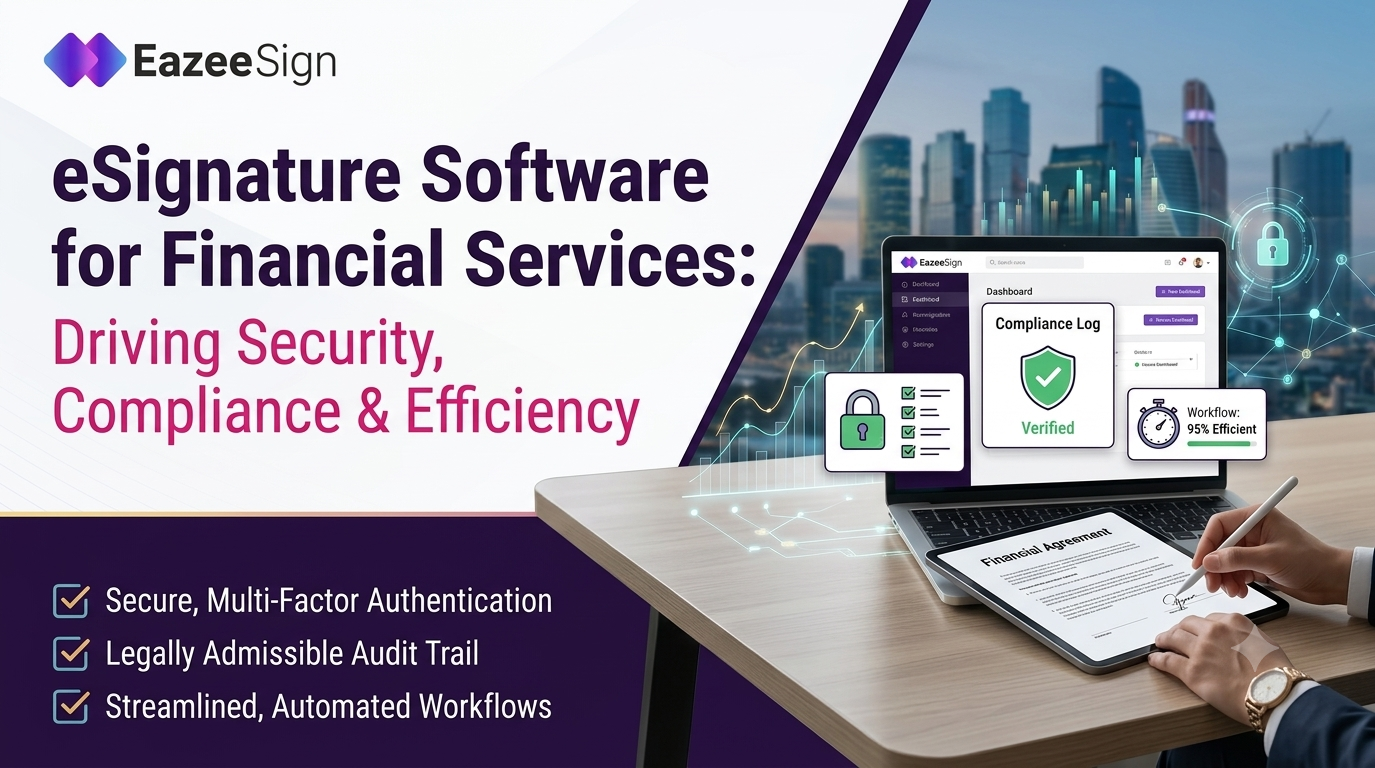
What backs that up is the audit trail. A real one shows a timestamp, the device used, the IP address, exactly who signed and from where, not just a vague record that a signature happened. If an institution ever needs to prove a document’s history during a regulatory review or a dispute, this is what gets checked first. A platform that skips this is not really built for financial services, whatever else it does well.
Security Comes First in Financial Documents
Financial paperwork carries account numbers, income details, identity documents, the kind of information that causes real problems if it leaks or gets altered. A tampered loan agreement is not just an inconvenience, it can mean a customer disputes terms they never actually agreed to, or a regulator asks hard questions about how a document changed after signing.
Tamper proof records handle this directly. Once something is signed, it locks, and any attempt to change it afterward shows up clearly. Two factor authentication adds another check, confirming the person signing is actually who they claim, not someone using a forwarded link or a shared device. For institutions moving thousands of documents a month, none of this is optional.
The eSign App for Banking and Finance Teams
Banking does not stay inside a branch anymore. Relationship managers meet clients at their office. Field agents complete loan paperwork at someone’s home. Insurance agents sign up policyholders wherever works for them that day. An eSign App fits this work naturally, letting a document get signed right there instead of being carried back for processing later.
This matters most in smaller towns, where a branch visit is a bigger ask than it sounds like from a city office. A field agent with a tablet finishes an entire loan application, signature included, without the customer ever needing to go anywhere. Security has to travel with the app too, two factor authentication and a full activity log working exactly the same way on a phone as inside a branch system.
What to Look for in eSignature Software for Financial Services
A few things separate software actually built for this industry from something that just happens to work. Compliance with the Information Technology Act, 2000 comes first, nothing else matters without it. A full audit trail follows close behind, since financial institutions answer to a higher record keeping standard than most businesses ever face, alongside how easily non technical branch staff can actually pick the tool up without a training session eating into their week.
Integration helps too. A signing tool that fits into whatever CRM or banking system already exists tends to get used. One that demands a separate workflow usually gets ignored within a month.
How EazeeSign Supports Financial Institutions
EazeeSign puts electronic and digital signature software workflows on one platform, which matches how financial institutions actually operate day to day. Routine paperwork, onboarding forms, internal approvals, runs through the electronic signature option. Higher risk documents, loan agreements, investment contracts, get the extra certificate backed verification of digital signatures instead.
It also works as a complete eSign software, letting relationship managers and field staff sign documents wherever they meet a customer that day. Every document carries a full audit trail, two factor authentication, and automatic reminders for anything still pending. For institutions handling high document volume, AI features summarize longer agreements and flag unusual clauses, catching something odd before a customer signs rather than after.
A free trial with full feature access is available, so an institution can test it against real documents before committing to anything.
Final Thoughts
Financial services run on documentation, and every delay in that paperwork costs something, a slower disbursement, a customer waiting longer than they should on a claim. Moving to eSignature software for financial services cuts that time down while actually tightening security and compliance instead of trading one for the other. Institutions making this shift tend to see faster turnaround, cleaner records, and customers who spend a lot less time waiting on paperwork that used to take days to clear.




