

B-1/E-23, Mohan Co-Operative Industrial Area, Mathura Road, Delhi-110044, India
- Electronic Signature
- 24-Sep-2026
- -
- 0 Comments
A vendor agreement sits in an inbox waiting for a pen and paper signature that has to travel across three offices before it is done. Meanwhile a similar deal down the hall closes in under ten minutes because the other party used electronic signature software instead. Same kind of document, wildly different timelines. That gap is really what this whole comparison comes down to.
What a Wet Signature Actually Involves
A wet signature is exactly what it sounds like, ink on paper, made by hand. The process behind it has not changed much in decades. Print the document, sign it then either scan it back in or mail the physical copy along to whoever’s next. Every step depends on someone being physically present with a pen at the right moment.
This still works fine for plenty of everyday agreements, but the friction adds up fast once more than one signer is involved or once distance gets thrown into the mix.
How Electronic Signature Software Actually Works
Electronic signature software captures a signer’s intent digitally instead of on paper. That can mean typing a name into a signature field — drawing one on a touchscreen or clicking to accept a document’s terms. Behind the scenes, a proper eSign app also logs identity verification, timestamps and a full audit trail showing exactly who signed and when.
This isn’t some legal gray area either. Most regions recognize electronic signatures as having the same legal standing as a handwritten one for the vast majority of everyday transactions — provided the software meets basic compliance requirements.
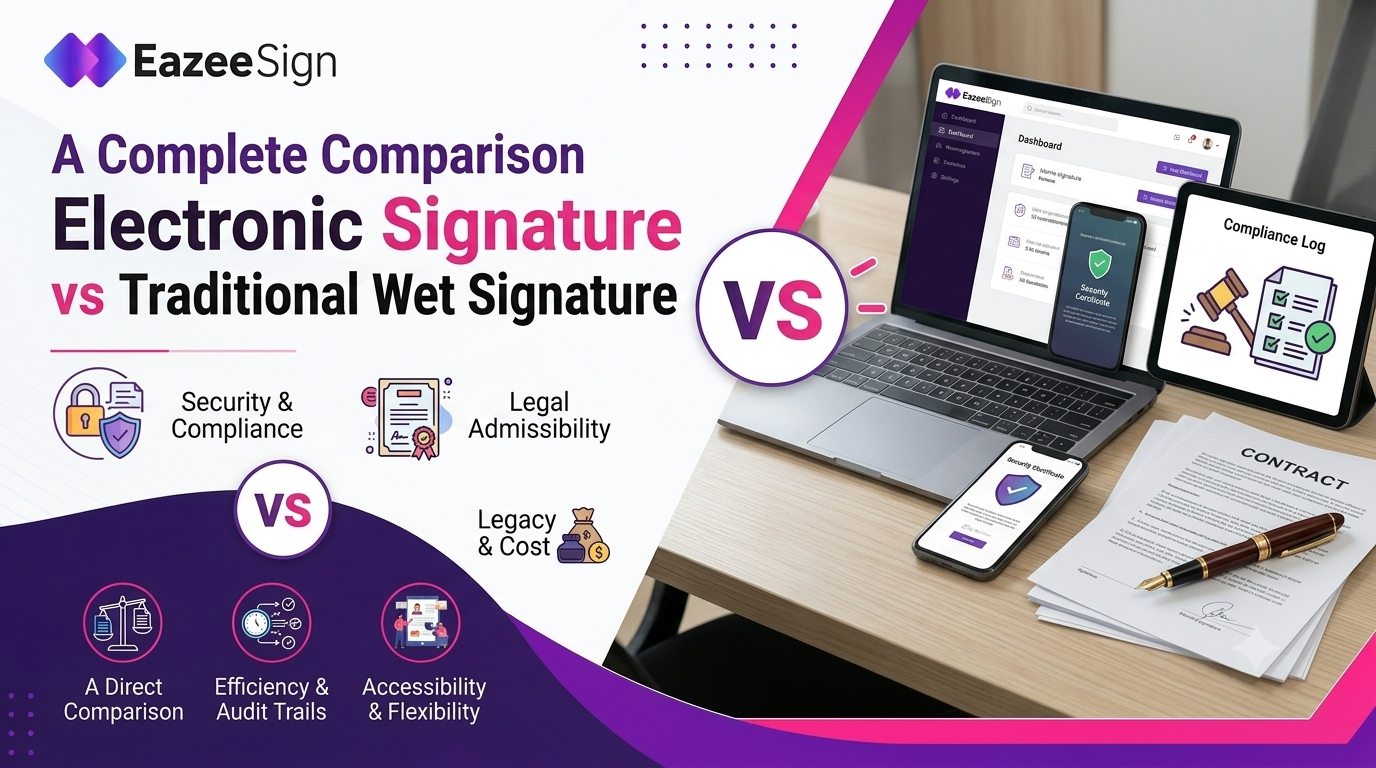
Electronic Signature vs Wet Signature: Side by Side
| Factor | Electronic Signature | Wet Signature |
| Signing process | Type, draw or tap to sign digitally | Print, sign by hand, scan or mail back |
| Speed | Minutes, from any device | Days, dependent on mail or in-person coordination |
| Security | Encryption, identity checks, audit trail | Vulnerable to forgery, loss or damage |
| Tracking | Real time status on who has signed | Manual follow up to confirm receipt |
| Storage | Centralized, searchable digital records | Physical filing or scanned copies |
| Remote signing | Works from anywhere | Requires physical presence or mail |
Laid out this way, the gap between the two is not subtle. Most of what slows a wet signature down simply does not exist once a document moves through digital signature software instead.
When a Wet Signature Still Makes Sense
Ink has not disappeared entirely and for good reason. Certain legal, government or notarized documents in some jurisdictions still require a physical signature by law. Anything needing an in-person witness generally falls into the same category, since the requirement isn’t really about the signature itself but the presence of another person confirming it.
There is also the occasional counterparty who simply prefers paper or is not set up to handle anything digital. Wills, testamentary trusts and most family law matters are commonly excluded from standard electronic signature rules too, which is why these specific categories still lean on pen and paper more than almost anything else.
When Electronic Signature Software Is the Better Call
For the overwhelming majority of everyday business agreements digital signing is now the default rather than the exception. Sales contracts, vendor agreements, employee onboarding paperwork, customer approvals, NDAs — these are typically high volume, low friction documents where speed and easy tracking matter more than a physical signature ever did.
A sales team trying to close before month end an HR department onboarding five new hires at once, a customer approving a service agreement from their phone, all of these benefit directly from not having to wait on the mail or coordinate an in person meeting just to get a signature.
Why So Many Businesses Are Making the Switch
The shift away from ink is not about chasing novelty. It is a practical response to how work actually happens now, more remote, faster paced, with less patience for paperwork that stalls a deal for no good reason.
A few things are driving this directly. Turnaround time drops from days to minutes once a document does not need to physically travel anywhere. Administrative work shrinks too, no printing, no scanning, no chasing down a missing signature page buried somewhere in someone’s desk drawer. Real time visibility replaces the guessing game of wondering whether a documents even been seen yet. Digital records with audit trails and timestamps create a far more tamper evident history than a signed page sitting in a filing cabinet ever could. And remote collaboration becomes genuinely simple — since signers in different cities or different countries no longer need to be in the same room to move a deal forward.
What to Look for in a Reliable eSign App
Not every tool handles this equally well so a few things are worth checking before relying on one for anything important. Encryption should cover a document both while it is being sent and once it’s stored. A detailed audit trail should log every action tied to a signature, not just the final result. Identity verification options should scale depending on how much is actually at stake with a given document.
Recognized certifications matter here too. Standards like SOC 2 and ISO 27001 involve independent audits of how a provider actually secures data offering a level of assurance that marketing language alone can not provide.
AI features are worth checking for as well since they have become a genuine differentiator rather than a gimmick. EazeeSign for instance, includes the following
- Risk Analysis that flags unusual clauses or missing terms before a document goes out for signing.
- Document Summary that condenses a lengthy agreement into a quick overview.
- Key Clause Detection that pulls out payment terms and deadlines automatically and Document Comparison that highlights exactly what changed between two versions of a contract.
Together, these catch a lot of the small mistakes that would otherwise slip through during a busy week, on top of the standard encryption and audit trail features a good eSign app should already have.
Where EazeeSign Fits Into This Shift
EazeeSign is built around exactly this transition, offering straightforward digital signature software alongside AI based features like risk analysis and key clause detection that flag unusual terms in a contract before it’s even sent out for signing. Backed by SOC 2 and ISO 27001 certifications — it covers the security fundamentals that matter regardless of how a business uses it day to day.
For teams still relying heavily on wet signatures for routine paperwork moving even a portion of that workflow to a proper eSign app tends to remove a surprising amount of daily friction almost immediately.
Final Thoughts
Wet signatures have not become obsolete, certain documents and situations still call for them specifically. But for the bulk of everyday agreements a business handles, electronic signature software offers real advantages that paper simply can not match, speed, security, tracking and a record that holds up if anything’s ever questioned later. Knowing when each approach actually applies, rather than defaulting to whichever one’s familiar is what separates a business moving efficiently from one still waiting on the mail.
Frequently Asked Questions
Is an electronic signature as legally valid as a wet signature?
Yes, in most regions and for most everyday transactions — provided the electronic signature software meets recognized compliance standards.
Can someone refuse to sign a document electronically?
Yes, most electronic signature laws require mutual consent to sign digitally so a business generally needs to offer a paper based alternative if someone objects.
Are there documents that still require a wet signature?
Yes, certain legal, government or notarized documents, along with wills and some family law matters, often still require a handwritten signature depending on the jurisdiction.
How does digital signature software prevent forgery compared to ink?
It relies on identity verification, encryption and a detailed audit trail which together make tampering far harder to pull off undetected than with a paper signature.
Can electronic signatures be used across different countries?
Generally yes, though specific requirements vary by region so it is worth confirming compliance for any international agreement before assuming it will be accepted.




